From iDEAL to Wero: What Dutch merchants need to know
Since 2005, iDEAL has been the backbone of online payments in the Netherlands.
Share this article


Used by nearly 100% of Dutch consumers, offered by over 210,000 businesses, and accounting for 70% of all e-commerce transactions in the Netherlands, it's the payment method your customers reach for without thinking.
On 31 December 2027, the European Payments Initiative (EPI) will decommission iDEAL and replace it with Wero, a pan-European payment initiative backed by 16 major European banks including the Dutch banks behind iDEAL. This is one of the most significant shifts in European payments in years. And while it brings real opportunities, it also brings practical considerations every merchant should understand before the transition reaches their business.
What is Wero?
Wero is built on iDEAL's bank-backed foundation, using a similar direct bank payment experience your customers already know. The key difference is scale. Where iDEAL operates within the Netherlands, Wero works across borders, and is already live in Belgium, Germany, and France, with the Netherlands joining as part of the transition.
For Dutch merchants, your customers will continue using their trusted banking apps though the migration. What changes is what’s required from you – new integration work, new contracts, and operational adjustments that take time to get right. For a full overview, read our guide Wero is here: What changes for your business.
The transition timeline
The move from iDEAL to Wero is happening in two phases, with a gradual rollout designed to maintain stability throughout.
Phase 1: Transition (2026)
In Q1 2026, iDEAL begins appearing alongside Wero branding. This is deliberately low impact, with customers seeing both names, but little else changes at first.
Throughout 2026, the technical migration runs in the background, moving transactions to Wero payment scheme with a focus on technical stability before any merchant-facing changes take effect.
By Q4 2026, the merchant rollout begins. This is when the practical work starts – migration steps, new contracts, and access to Wero’s capabilities including cross-border payments and new payment options for your customers across Europe.
Phase 2: Full rollout (2027)
Through the first three quarters of 2027, Wero's capabilities continue to expand. On 31 December 2027, the migration is finalized and the EPI decommissions iDEAL.
What stays the same
Your customers will still pay directly from their bank account, within the environment they already trust. The checkout experience remains familiar throughout the transition.
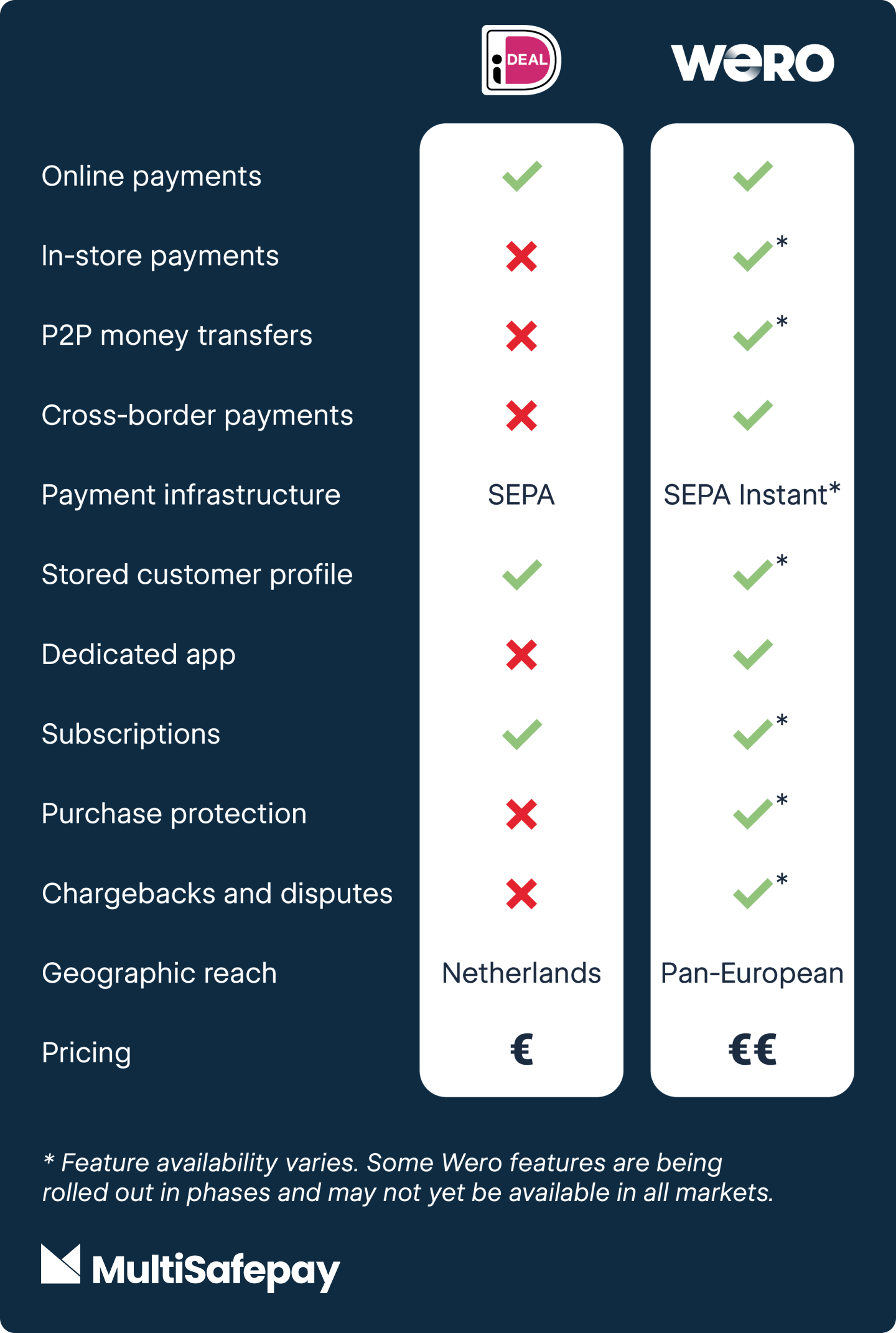
What's different, and what to prepare for
Wero is being marketed to consumers as a direct replacement for iDEAL. For merchants, the reality is more nuanced. Here is what deserves your attention.
Chargebacks and disputes.
Under iDEAL, you handle complaints directly with your customer. Under Wero, customers can raise disputes weeks after a transaction. If you reach no resolution, your Payment Service Provider (PSP) steps in, and if the issue remains unresolved, the PSP is held accountable. This shift in liability has real consequences. PSPs are likely to tighten their due diligence, and some sectors may find it harder to access Wero altogether. There is also a recognized risk of friendly fraud - where consumers make a legitimate purchase and later dispute it falsely. EPI is still establishing the framework governing how all of this works, so it is worth monitoring closely.
Pricing.
Wero transaction costs are expected to be higher than iDEAL. Beyond the base transaction fee, PSPs are likely to build in additional margin to account for the increased risk that Wero’s dispute framework introduces. For merchants selling across borders, cross-border fees will likely drive up costs further.
Payouts and reserves.
Under Wero, PSPs and the scheme will need to cover potential consumer claims, which could lead to longer settlement delays or reserve requirements in your account. The exact terms are still being defined, so keep a close eye on developments.
Recurring payments and subscriptions.
iDEAL currently supports recurring payments via SEPA. Wero handles this differently, and if you currently rely on SEPA for subscriptions or recurring billing, you might need to make changes to your process before the transition completes.
New features rolling out in phases.
Not everything Wero offers will be available from day one. In-store payments, purchase protection, and some recurring capabilities are being rolled out gradually. Feature availability will also vary by market.
The bigger picture
For Dutch merchants, Wero is not a like-for-like switch. It brings genuine opportunity, especially for those looking to reach customers across borders, but it also brings higher costs, new contracts, and an evolving dispute landscape that requires real preparation. The industry is still working through some of the details, and the rules will continue to develop over the coming months.
We are to make sure you're ready for it.
Next steps
The transition is already underway, and preparation takes time. If you have questions about what this means for your specific setup, whether that's pricing, recurring payments, or your integration - our local team is ready to help. Get in touch with our sales team.