Interchange fees explained, so you know exactly what you’re paying for
Understand exactly what you pay in card processing fees. See how interchange fees and Interchange++ work, and how they compare to blended pricing.
Share this article


Do you know exactly where every cent of your card processing fee goes? Card payments are how most of your customers pay, and they're also one of the least transparent costs in your business, if you've never had someone walk you through them properly.
Every card transaction carries a fee. What often isn't clear is where that fee goes, who sets it, and why it changes from one transaction to the next. At MultiSafepay, we've helped thousands of merchants across Europe understand exactly what sits behind their payment fees, so nothing is left to guesswork.
This guide breaks down interchange fees, how Interchange++ pricing works, and how it compares to blended pricing, so you know precisely what you're paying for and can decide what fits your business.
What are interchange fees?
An interchange fee is the fee paid to the customer's bank (the issuer) every time they pay by card. It covers the cost the issuing bank takes on for authorizing and guaranteeing the transaction.
Interchange fees aren't set by MultiSafepay. They're set by the card schemes, such as Visa and Mastercard, but the fee itself is paid to the issuing bank, not to the scheme. The scheme sets the rate; the bank receives it.
In the EU, interchange on consumer debit and credit cards is regulated and capped under the Interchange Fee Regulation. Corporate and commercial cards fall outside this cap, which is one reason they typically cost more to accept than a standard consumer card. It's worth remembering that this cap applies to the interchange fee only, one of three parts that make up your total Interchange++ cost, not the fee as a whole.
What is Interchange++?
Interchange++ (IC++) is a transparent pricing model for card payments that splits your total processing cost into three separate parts, instead of bundling everything into one number.
What’s in the fee | Where it goes | What it’s for |
Interchange fee | The customer's issuing bank | Covers the bank's cost of handling the transaction. Regulated and capped in the EU for consumer cards |
Scheme fee | The card network (e.g. Visa, Mastercard) | Paid to the scheme for running the card network |
Acquirer fee | MultiSafepay, as your acquirer | Our fee for processing and supporting the payment |
That's the "++": interchange fee, plus scheme fee, plus acquirer fee. Instead of a single flat rate, you see exactly what each part costs and who it's paid to.

Think of it as an itemized bill rather than a set menu price. You still pay for the meal, but you can see the food, the drinks, and the service charge separately, which means you can actually assess each part.
What affects the interchange fee on each transaction
Interchange++ fees move because the underlying costs move. The main factors are:
- Card type: debit, credit, prepaid, corporate versus consumer
- Customer location: cards issued within the EEA are capped the same whether the payment is domestic or cross-border within Europe. Cards issued outside the EEA fall outside that cap and typically cost noticeably more.
- Payment channel: online, in-store, or mobile, each carries a different risk profile for the issuing bank, which affects the rate
- Card scheme: Visa, Mastercard, and other networks each set their own rates
- Merchant profile: your industry or business segment can influence the fee structure
- Monthly volume: higher transaction volumes can unlock better pricing tiers
MultiSafepay adds its acquirer fee on top of this, agreed in advance. So you're not paying the same flat rate for every card. You're paying the actual cost of that specific transaction, plus a clear, predictable fee for your provider. Interpreting what those variables mean for your business is where a payment partner should be doing more than showing you a statement. That's the difference between a provider and an advisor.
Interchange++ vs blended fees: which one is right for you
Interchange++ and blended pricing are both valid models. The right one depends on your transaction volume and how much visibility you want into individual fees.
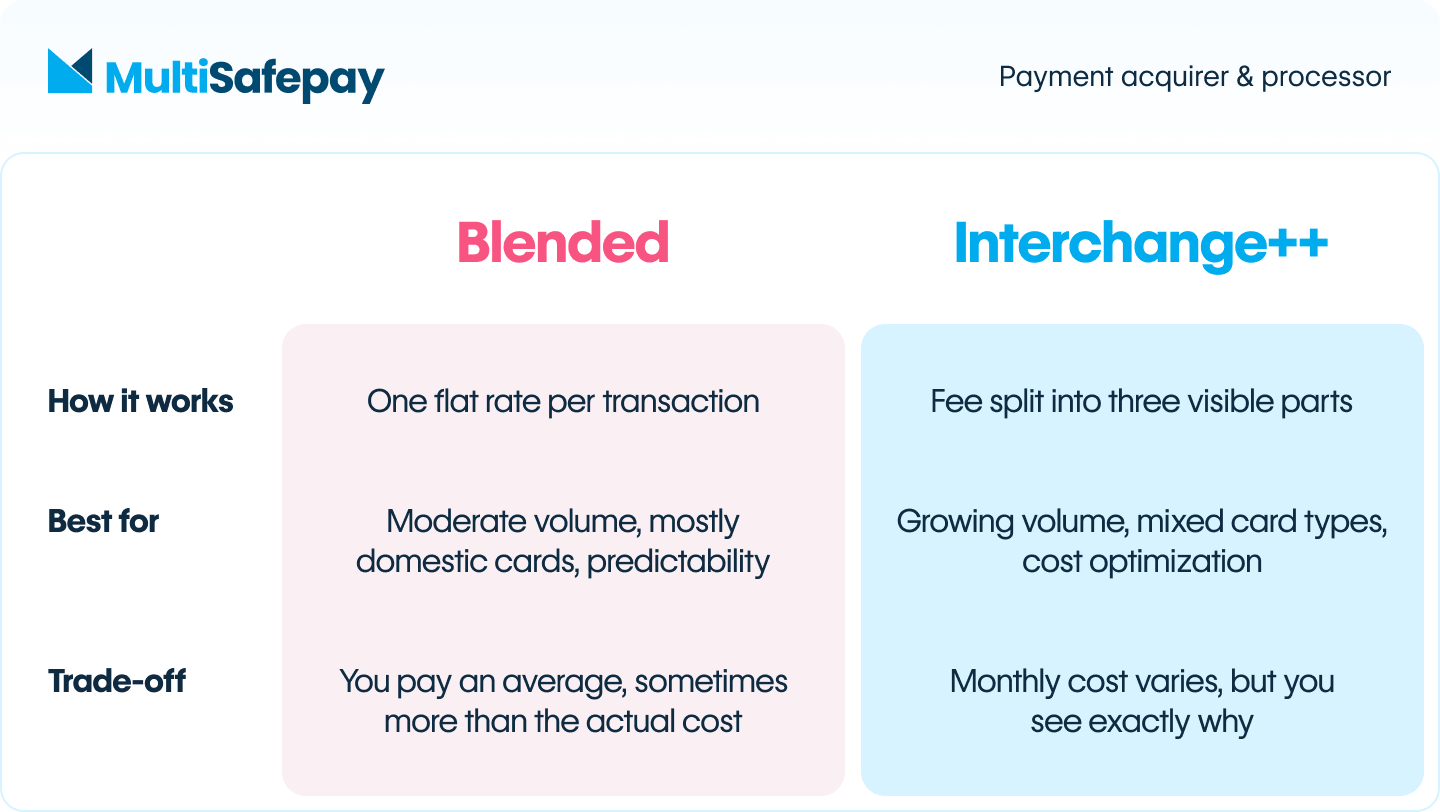
Blended pricing gives you one fixed rate per transaction (for example, €0.30 + 1.5%), regardless of card type, region, or channel. There's no breakdown of what makes up that number.
- Best fit if: your transaction volume is modest, your card mix is fairly uniform (mostly domestic consumer cards), and predictability matters more to you than optimization.
- Trade-off: you're paying an averaged rate. On lower-cost transactions, you're likely paying more than the actual cost. On higher-cost ones, your payment provider absorbs the difference, which is priced into the flat rate you're charged.
Interchange++ pricing breaks every transaction into its interchange, scheme, and acquirer fee components.
- Best fit if: your volume is growing, you process a mixed range of card types or international cards, or you want the visibility to identify where costs are highest and optimize around it.
- Trade-off: your monthly cost will vary from transaction to transaction. That variability is the price of transparency, and for most scaling merchants, it's worth it.
At MultiSafepay, we offer both, and we'll tell you plainly which one fits your business rather than defaulting to whichever is easier to sell.
Is your current pricing model still right for you?
The right pricing model isn't a one-time decision. As your volume grows, your card mix shifts, or you expand into new markets, the model that made sense a year ago might not be the best fit today.
A few signals worth checking against your own account:
- Your transaction volume has grown significantly since you last reviewed your pricing. Higher volume often unlocks better rates under Interchange++, rates that a blended model won't reflect.
- Your card mix has changed. More international customers, more corporate cards, or a shift in payment channel (say, adding in-person alongside online) all affect what you're actually paying per transaction, and whether a flat blended rate still represents good value.
- You're expanding into new markets. Cross-border transactions carry different interchange costs. If this is new territory for your business, it's worth checking whether your current model still makes sense.
- You've never had your pricing explained in detail. If you're on blended pricing and don't know what's driving the rate, or you're on Interchange++ and haven't looked at the breakdown in a while, that's reason enough for a check-in.
If any of that sounds familiar, it's worth a conversation, not because something is wrong, but because the right model changes as your business grows. It’s easier to make the call with the data in front of you than spot it months down the line.
Where interchange fees fit in the payment process
Interchange doesn't happen in isolation. It's calculated during the clearing stage of the acquiring process, using the transaction data captured at authorization. The fees are then deducted during settlement, when funds are paid out to you.
For Interchange++ merchants, the scheme and interchange fee you see on each transaction is an estimate agreed in advance. At the end of the month, that estimate is compared against the actual cost reported by the schemes, and the difference is corrected in one line under "Interchange details" on your monthly invoice.
In short:
- Authorization: the transaction is approved in real time
- Clearing: interchange, scheme, and acquiring fees are calculated based on the authorization data
- Settlement: fees are deducted and the remaining funds are paid to you
Interchange is one piece of a larger process that your acquirer manages end to end. If you want the full picture of how acquiring, processing, and interchange work together, we've broken that down in our Merchant Acquirer guide.
Get a clear view of your current fees
If it's been a while since you looked closely at your pricing, or your business looks different than it did when you set it up, the breakdown of what you're paying and why is already sitting in your monthly invoices, accessible in your MultiSafepay Control Panel.
We work with merchants at every volume and stage of growth, and we don't default to whichever pricing model is easier to sell. If you want to talk through what your numbers mean or whether your current model still fits, we're here for that too.
Frequently Asked Questions
<h6>Is Interchange++ more expensive than blended pricing?</h6>
Not inherently. Interchange++ shows you the real cost of each transaction rather than an averaged rate, which can work out cheaper for merchants with strong or growing volumes, though month-to-month costs will vary more than with blended pricing.
<h6>Who actually receives the interchange fee?</h6>
The customer's issuing bank. Your payment provider doesn't set this rate or keep it; it's paid to whichever bank issued the card used in the transaction.
<h6>Can I switch from blended to Interchange++ later?</h6>
Yes. As your volume and card mix change, it's worth revisiting which model fits best. This is exactly the kind of conversation to have with your payment partner as your business scales.