More than half of Spain's E-comm is cross-border. Is your checkout ready?

Expanding into a new market often feels harder than it should. New audience, new competitors, new rules to learn. But for a lot of merchants, the real friction sits somewhere less visible: at the checkout.
Share this article


Take Spain. In Q1 2026, 68.9% of e-commerce turnover crossed a border. 56.0% was Spanish shoppers buying from businesses abroad, and 12.9% was shoppers abroad buying from businesses in Spain. That inbound flow reached €3.833 billion, up 15.3% year on year and slightly ahead of the 14.0% growth in outbound spending. It is still much smaller than the €16.604 billion Spanish shoppers spent abroad, but it is growing at double digits, and it only turns into sales for merchants whose checkout is built to capture it, not lose it at the last step.
The local payment map across europe
Local payment preferences vary sharply by market, and that matters more the more cross-border shoppers you serve.
- Bizum leads in Spain
- MB WAY is the standard in Portugal
- MyBank is one of the top payment methos in Italy
- IDEAL|Wero remains dominant in the Netherlands, and is rolling out in Belgium, Germany and France
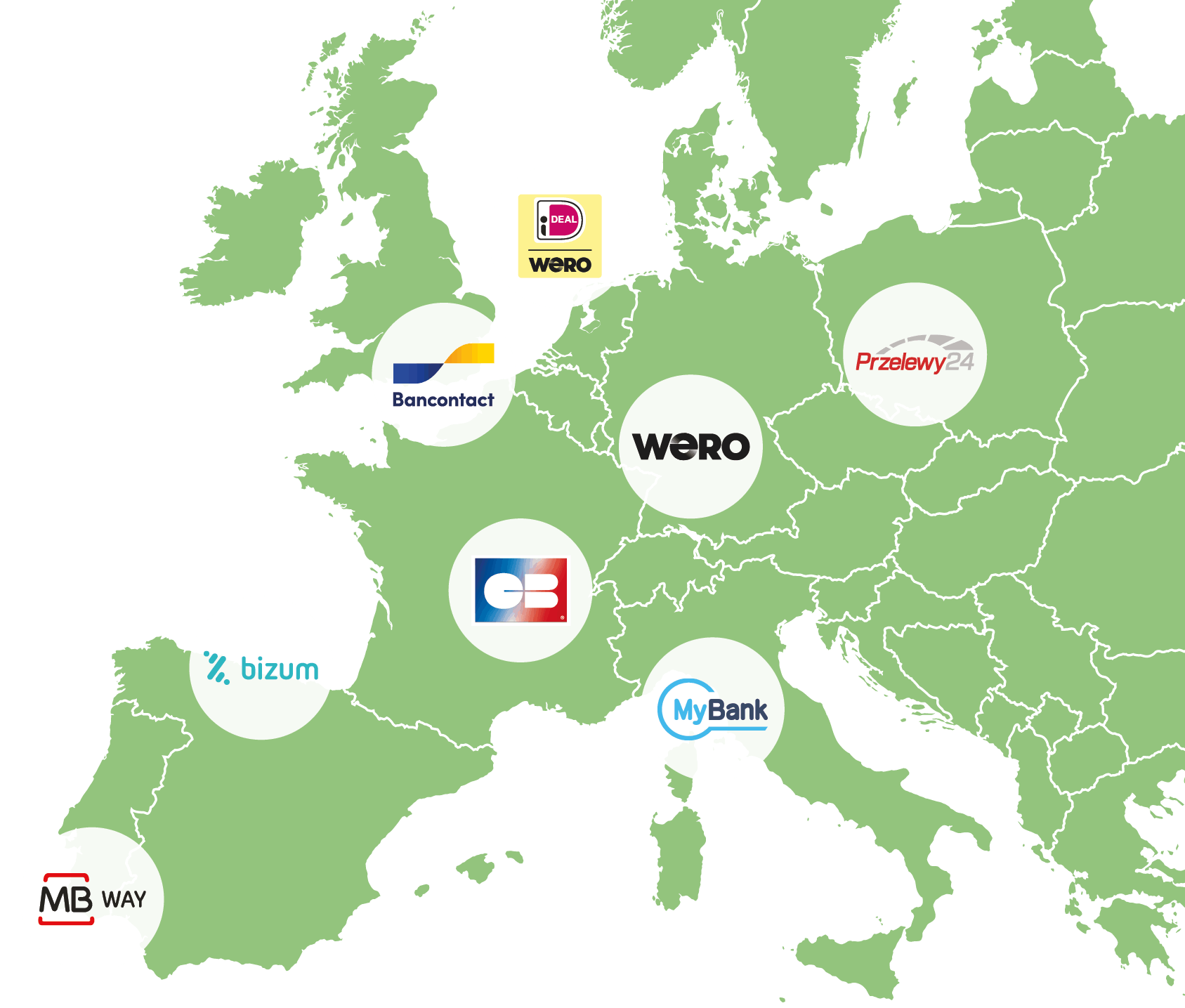
For merchants selling across borders, that's four different expectations from four neighbouring markets. Meeting shoppers with the method they already trust is one of the simplest ways to reduce friction at checkout. See the full country-by-country breakdown in our free report.
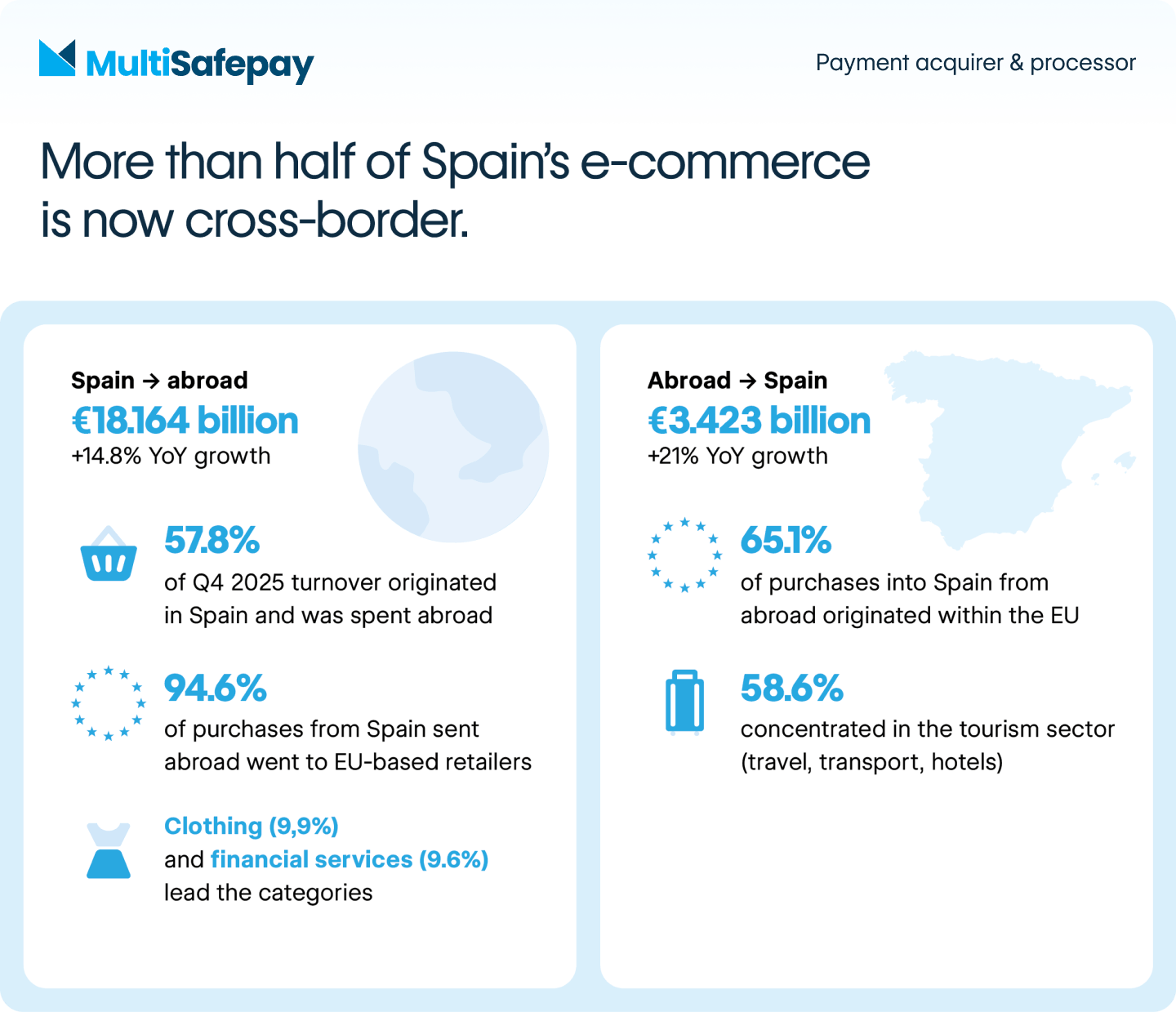
Of that inbound cross-border volume, 65.1% originated within the EU. That's a lot of shoppers arriving from a small number of neighbouring markets, each with their own payment habits. More on which markets, and which methods, further down.
Spain's e-commerce market keeps growing at double digits
Spain's e-commerce sector had a strong 2025. Full-year turnover reached €114.8 billion, up 20.6% year on year, and Q4 2025 alone grew 22%. In Q1 2026, turnover reached €29.643 billion, up 15.1% on the same quarter a year earlier, across more than 549 million transactions (+16.0%). Growth has moderated from the Q4 pace, but it is still firmly double-digit.
Growth at this pace changes the competitive picture, not just the size of it. More shoppers means more competition for their attention, and a shorter list of merchants who convert that attention into a sale. For merchants selling in Spain, or planning to, the market is moving fast enough that checkout experience, not just product or price, becomes a deciding factor in whether demand converts. A shopper who hesitates at an unfamiliar payment screen doesn't wait around. They go to the merchant next door who made it easy.
The cross-border opportunity merchants are missing
Within that overall growth, cross-border is where most of the turnover sits. Outbound spending reached €16.604 billion (+14.0%) and inbound reached €3.833 billion (+15.3%), while domestic e-commerce grew fastest, up 17.0% to €9.207 billion. All three flows are growing at double digits, and inbound is edging ahead of outbound.
Spanish shoppers are clearly comfortable buying across borders: outbound accounts for 65.3% of all e-commerce transactions in Spain.
Where does inbound demand come from? Almost two-thirds of it (64.8%) originates within the EU, for merchants, that makes local payment habits across European markets the first place to look.
What spanish shoppers buy abroad and what's coming in
The two directions of that cross-border flow don't look alike. What Spanish shoppers buy when they shop abroad is a different basket entirely from what's driving purchases into Spain.
Outbound, the leading categories are auxiliary services to financial intermediation (9.8% of outbound turnover) and clothing (8.6%).
Inbound, tourism dominates. Travel-related sectors (travel agencies, air transport, land transport, car rental and hotels combined) accounted for 61.6% of all purchases coming into Spain. Travel agents and tour operators alone represent 28.8%, hotels 14.2% and air transport 12.9%.
Inbound is also a high-value flow. It accounts for 12.9% of Spain's e-commerce turnover but only 5.0% of transactions, which implies an average inbound transaction roughly 2.5 times the average across all e-commerce (our calculation from CNMC figures). Fewer, larger payments mean every abandoned checkout costs more.
Why card alone no longer wins the sale
Here's the blocker most merchants don't see coming: 44.4% of online purchases in Spain already use something other than a card. That figure is roughly 18 months older than the market data above, so treat it as a signal of a trend already underway rather than a current-quarter number. The direction, though, is clear: nearly half of Spanish online shoppers are reaching for something other than a card at checkout.
For merchants that only offer card payments, that's not a market quirk to note and move past. It's active checkout friction, and it shows up at the exact moment a sale is won or lost. A shopper who doesn't see their preferred payment method has to stop and think, enter card details they'd rather not, or hunt for another way to pay. Some will. Others won't, and the cart gets abandoned instead. Multiply that across a growing volume of cross-border shoppers, and the gap between a card-only checkout and a locally adapted one starts to show up directly in the conversion rate.
How merchants can capture this growth
Knowing that local methods matter is one thing. Building a checkout that acts on it, without adding complexity on the backend, is another.
This is where we come in. MultiSafepay's platform is built for exactly this kind of market complexity, local methods, multiple markets, shifting shopper habits, handled through one modular setup rather than a separate technical project for each.
Two places to start:
- Offer the local payment methods a target market actually uses, not just the ones that are easiest to integrate. With MultiSafepay, local methods are added to an existing setup rather than built from scratch each time, so expanding into a new market doesn't mean starting the technical work over. As shopper habits shift (iDEAL's transition toward Wero is a live example), the checkout can shift with them.
- Adapt and optimize the checkout experience to each shopper. Show the methods that fit their location or basket value rather than a long list of options, and keep the checkout embedded on your own site instead of redirecting shoppers to an unfamiliar page, where doubt costs conversions. Behind the scenes, direct payment integration and smart routing help keep conversion high without a third party in between.
Local teams support that setup market by market, so merchants aren't left working out each market's conventions alone. That's the difference between adding a payment method and actually being ready for the shopper using it.
These are two of the four steps covered in full in the whitepaper, including how to sequence local methods by market and where automation can do the heavy lifting.