Smart Routing: What is it and how it helps you capture more sales
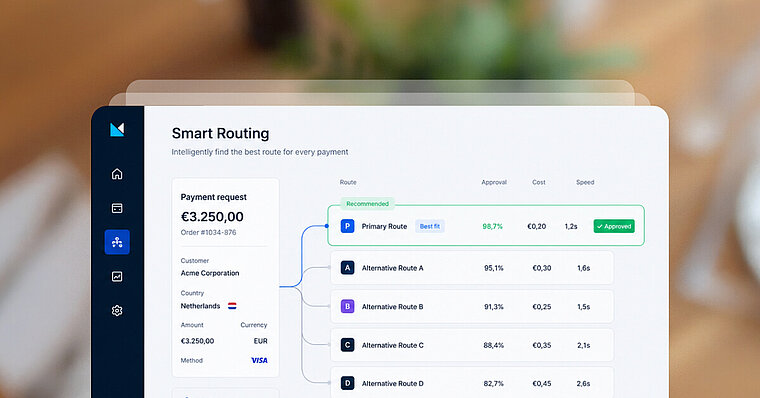
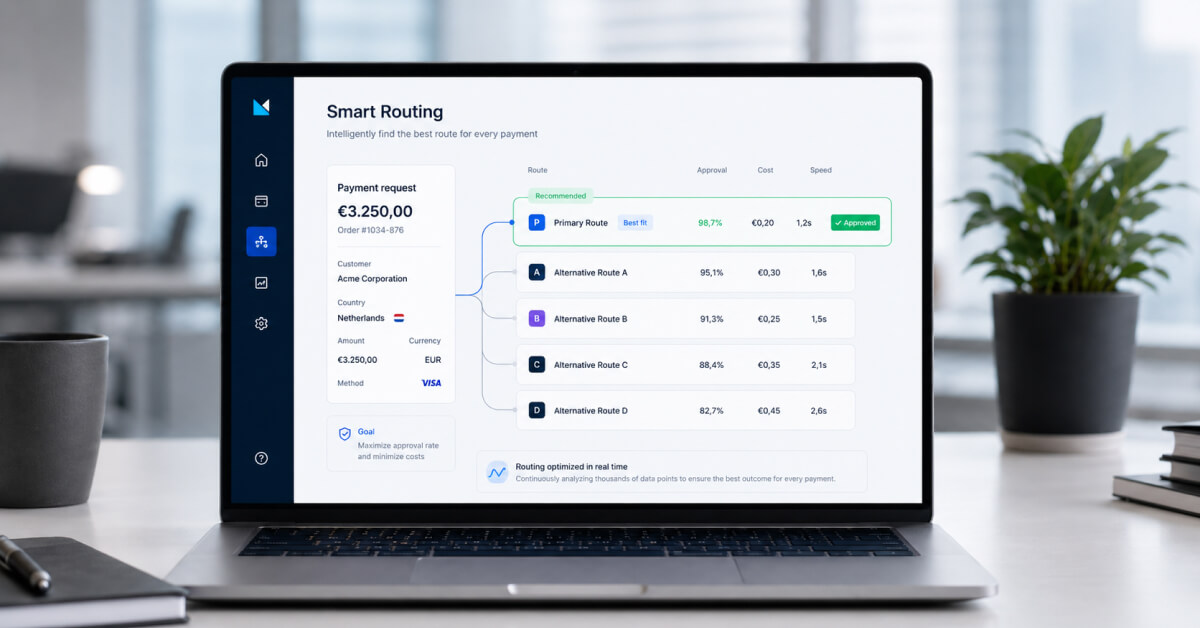
Smart routing is a payment optimization capability that automatically selects the most effective processing route for each transaction. In real time, before the customer notices anything has happened.
Share this article


Behind every completed payment, dozens of decisions happen in milliseconds. The route a transaction follows (how the transaction is processed before authorisation) directly affects whether it succeeds or fails. Smart routing makes those decisions intelligently, directing each payment through the path most likely to result in successful authorization.
The result: fewer failed payments, higher authorization rates, and more completed purchases without changing anything your customer sees at checkout.
Smart routing explained in detail
Smart routing evaluates transaction conditions dynamically and determines which processing option gives that specific payment the strongest chance of success. Instead of sending every transaction through a fixed path, it adapts in real time based on factors like:
- Customer location and market
- The payment method selected
- Historical issuer response patterns
- Cross-border processing conditions
- Network availability at the time of transaction
For customers, the process is invisible. For merchants, the impact shows up in authorization rates, completed checkouts, and revenue.
How smart routing works
Because payment failures are often caused by hidden processing issues rather than customer intent, smart routing helps reduce avoidable declines by selecting the most effective payment path, as explored in our guide on strategies to recover declined payments. Smart routing happens in milliseconds. A simplified payment flow looks like this:
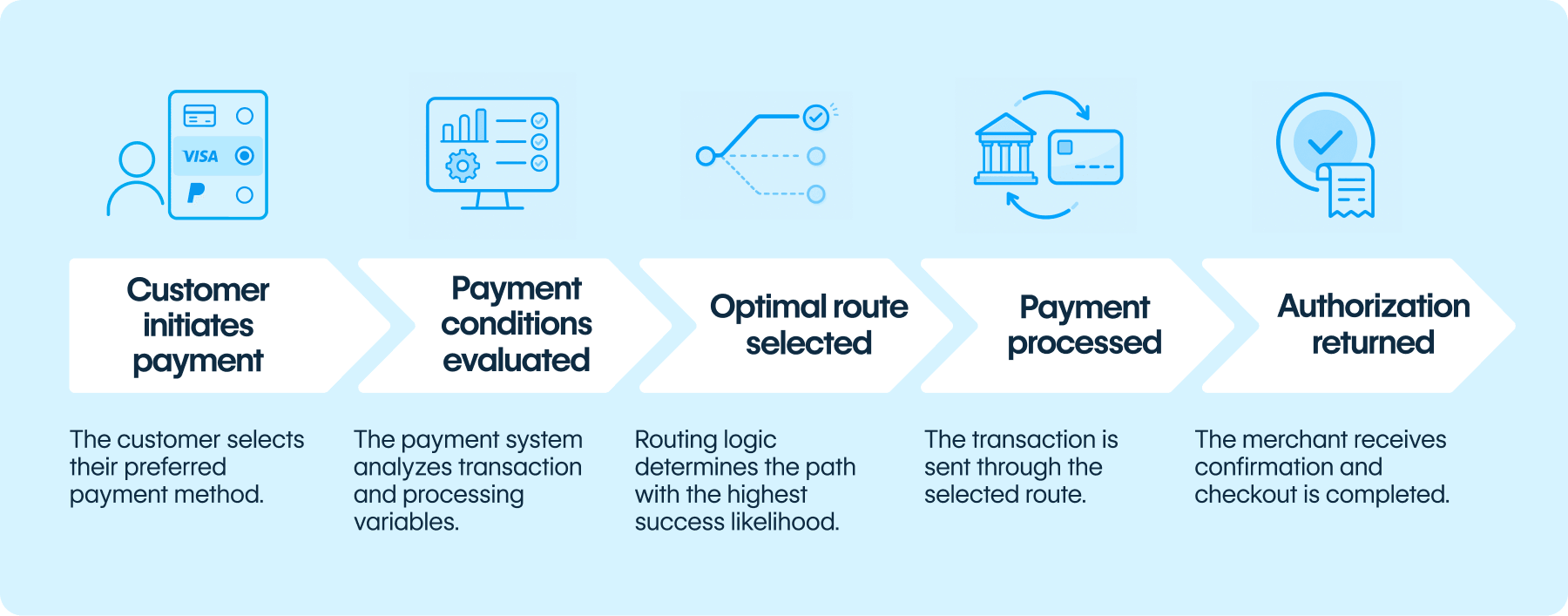
- Step 1. Customer initiates payment: the customer selects their preferred payment method.
- Step 2: Payment conditions are evaluated: the payment system analyses transaction and processing variables.
- Step 3: The optimal route is selected: routing logic determines which path gives the transaction the strongest chance of success.
- Step 4: Payment is processed: the transaction is sent through the selected route.
- Step 5: Authorization is returned : the merchant receives confirmation and checkout is completed.
The customer experience remains consistent. The payment journey stays intact.
Let's look at an example:
Two customers purchase the same product on the same day: one from Spain and one from Belgium. The checkout experience stays the same, but behind the scenes Smart Routing adapts the payment path to improve approval rates and payment performance in each market, including local methods and payment behavior.
Table: Comparison of fixed payment routing vs smart routing across performance, cost, and local optimization.
Nothing changes for the customer. But behind the scenes, each payment takes the path most likely to succeed in its specific market context.
This kind of dynamic routing is especially powerful when combined with embedded payments at checkout that automatically displays the right payment methods for each customer's location, reducing friction before the routing decision even needs to be made.
That's the difference between a payment setup that processes transactions and one that optimizes them.
Smart routing and payment authorization rates
Authorization rates measure how many payment attempts become successful transactions and are one of the clearest indicators of payment performance and one of the most direct levers for revenue. Because smart routing typically operates during the acquiring stage of the payment flow, it can influence how efficiently transactions reach authorization.
Smart routing doesn't guarantee approvals. No routing logic can.
Instead, it is part of a broader payment optimisation strategy alongside capabilities such as exemption handling, automated retries and authentication optimisation, all working together to maximise successful authorisation.
- That can help merchants:
- Reduce avoidable declines
- Recover revenue you'd otherwise lose quietly
- Improve consistency across markets as you grow
- Capture more of the sales your checkout is already generating
If you're also looking to optimize your checkout more broadly, authorization rate improvements work best as part of a complete conversion strategy, not on their own.
How smart routing supports international growth
Different markets behave differently. Issuers perform differently. Customer payment preferences vary significantly across Europe.
As you grow internationally, maintaining consistent payment performance becomes harder. Not because your product changes, but because payment infrastructure doesn't naturally adapt to each market.
One important factor in how effectively smart routing supports international growth: the range of local payment methods available at checkout. Smart routing can only optimize across the routes it has access to. The broader your local payment method coverage, (iDEAL| Wero in the Netherlands, Bancontact in Belgium, or cards in Spain and Italy) the more options the routing logic has to work with, and the more effectively it can match each transaction to the right path.
Smart routing helps you maintain performance without rebuilding your payment setup market by market.
Combined with local payment methods and a unified platform, smart routing becomes a practical growth lever.
Growth shouldn't mean more complexity. It should mean better infrastructure.
When does smart routing become relevant for your business?
Smart routing becomes increasingly valuable when you're:
- Expanding into new European markets
- Adding more payment methods to your checkout
- Processing growing transaction volumes
- Noticing higher decline rates without a clear reason
- Focusing on checkout conversion as a growth lever
The signals often appear indirectly. You notice more checkout abandonment. Authorization rates dip. Revenue seems lower than expected given your traffic.
Those are signs that your payment setup has room to work harder for you.
Smart routing and payment performance: the bottom line
Smart routing doesn't operate on its own. Its impact depends on the infrastructure around it: unified payment data, local method coverage, and the ability to adapt as your markets evolve.
When those foundations are in place, the results follow. Fewer avoidable declines, more completed purchases, and a payment setup that scales with your business without adding operational complexity as you scale.
Because payments aren't the destination. Growth is.
Find the right payment solution for you
Smart Routing FAQs
Does smart routing reduce failed payments?
It can reduce avoidable payment failures by ensuring transactions follow the route most suited to their context, rather than a fixed path that may not perform well in every situation.
Does smart routing improve conversion?
It can contribute to higher checkout conversion by helping more payments complete successfully, particularly for merchants operating across multiple markets or processing high transaction volumes.
Does smart routing help with cross-border payments?
Yes. One of its strongest use cases is cross-border commerce, where market conditions, issuer behaviour, and network performance vary significantly. Smart routing helps maintain consistent payment performance across markets.
Is smart routing only relevant for large businesses?
No. While transaction volume increases its impact, merchants of different sizes can benefit, particularly those expanding internationally, adding payment methods, or experiencing higher decline rates than expected.