What Is Tokenization? How it works and why merchants need it
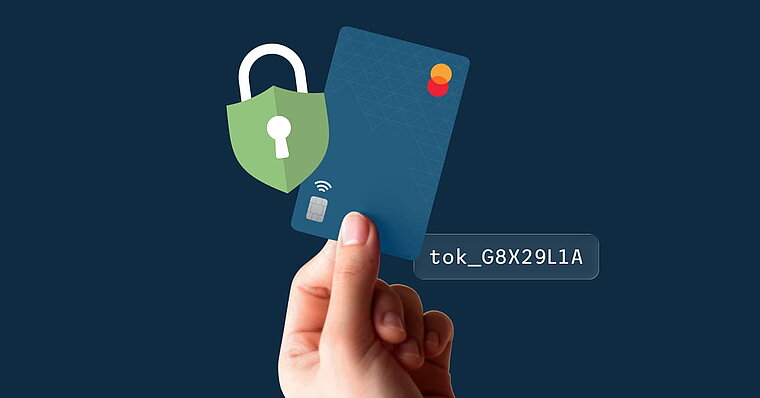
Payment tokenization is the process of replacing sensitive payment data, such as a customer's card number, with a unique payment token that can be safely stored and used for future transactions. The original card details remain securely stored by a PCI DSS-certified payment service provider (PSP), while merchants store only the token.
Share this article


Tokenization makes one-click checkout, saved payment methods, recurring payments, and subscriptions possible without merchants storing customers' sensitive card data. It also helps reduce PCI DSS scope and supports a faster, more secure checkout experience.
Why tokenization matters?
Every extra step at checkout creates friction. Returning customers don't want to re-enter their payment details every time they make a purchase, and merchants don't want the responsibility of storing sensitive card data.
Payment tokenization solves both challenges. Customers can securely save their payment method for future purchases, while businesses can offer faster repeat checkouts, recurring billing, and one-click payments without handling customers' card details themselves.
For customers, that means a quicker, more convenient checkout experience. For merchants, it can mean higher conversion rates, more repeat purchases, and a payment infrastructure that's ready for modern commerce.
What is a payment token?
As we mentioned before, a payment tokenization is the process of replacing sensitive payment data (such as a Primary Account Number -PAN) with a randomly generated identifier known as a token.
Unlike encryption, which transforms data into an unreadable format that can later be decrypted with the correct key, tokenization replaces sensitive payment data with a token that has no mathematical relationship to the original card number.
Here's a visual example:
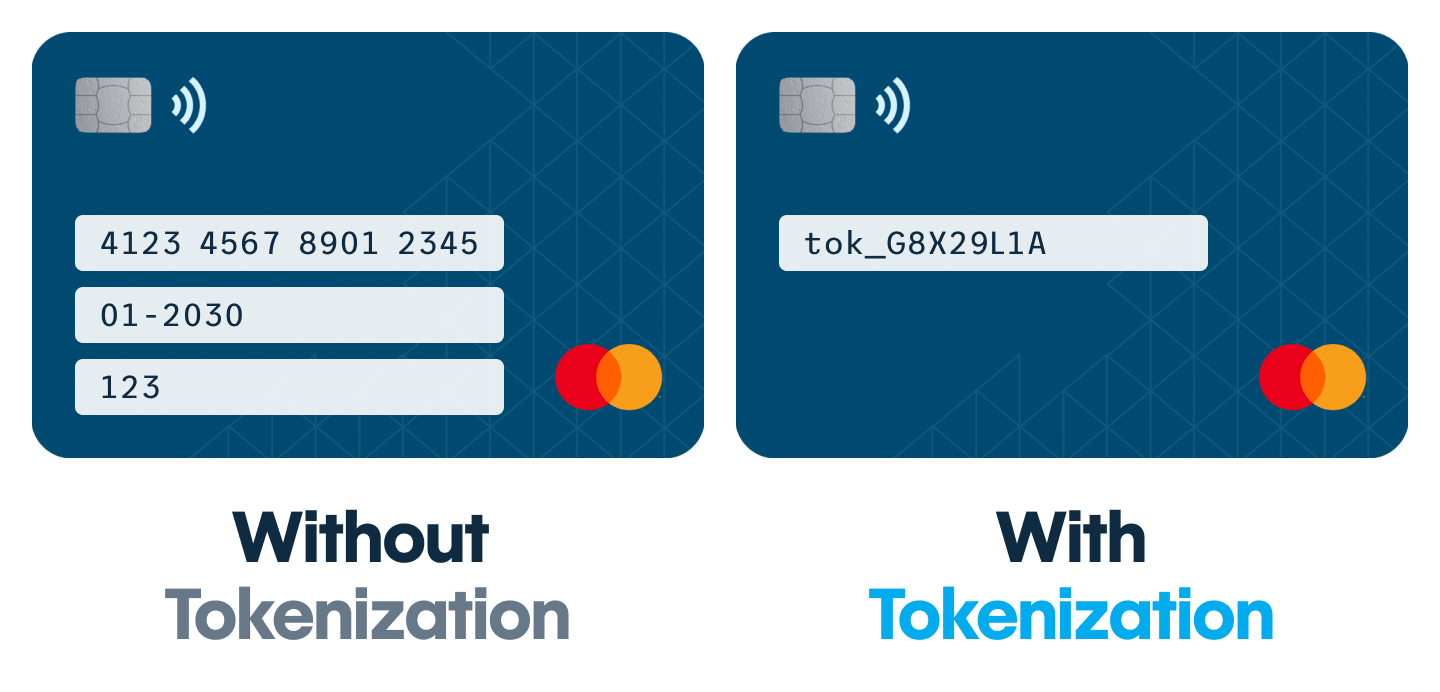
The token is what merchants store and use for future transactions instead of the customer's actual card details.
The original card data stays locked inside your payment provider's secure token vault. When you need to process a payment, the payment processor maps the token back to the original card number in their secure environment.
Types of payment tokenization
Not all payment tokens are the same. Depending on how a payment is processed, different layers of tokenization may work together behind the scenes.
1. PSP tokenization
Generated by your payment service provider and used for saved cards, one-click checkout and subscriptions. Merchants store only this token.
2. Network tokenization
Issued by Visa and Mastercard. Network tokens can automatically update when cards expire or are replaced, helping improve authorization rates.
3. Wallet tokenization
Digital wallets such as Apple Pay and Google Pay create device-specific payment tokens. Instead of sending the customer's card number during a transaction, the wallet sends a secure payment token, adding another layer of protection.
How Tokenization Works
The merchant never stores the customer's card details. The PSP (MultiSafepay) securely stores the payment credentials in their PCI DSS-certified environment and returns a PSP token that can be safely used for future payments.
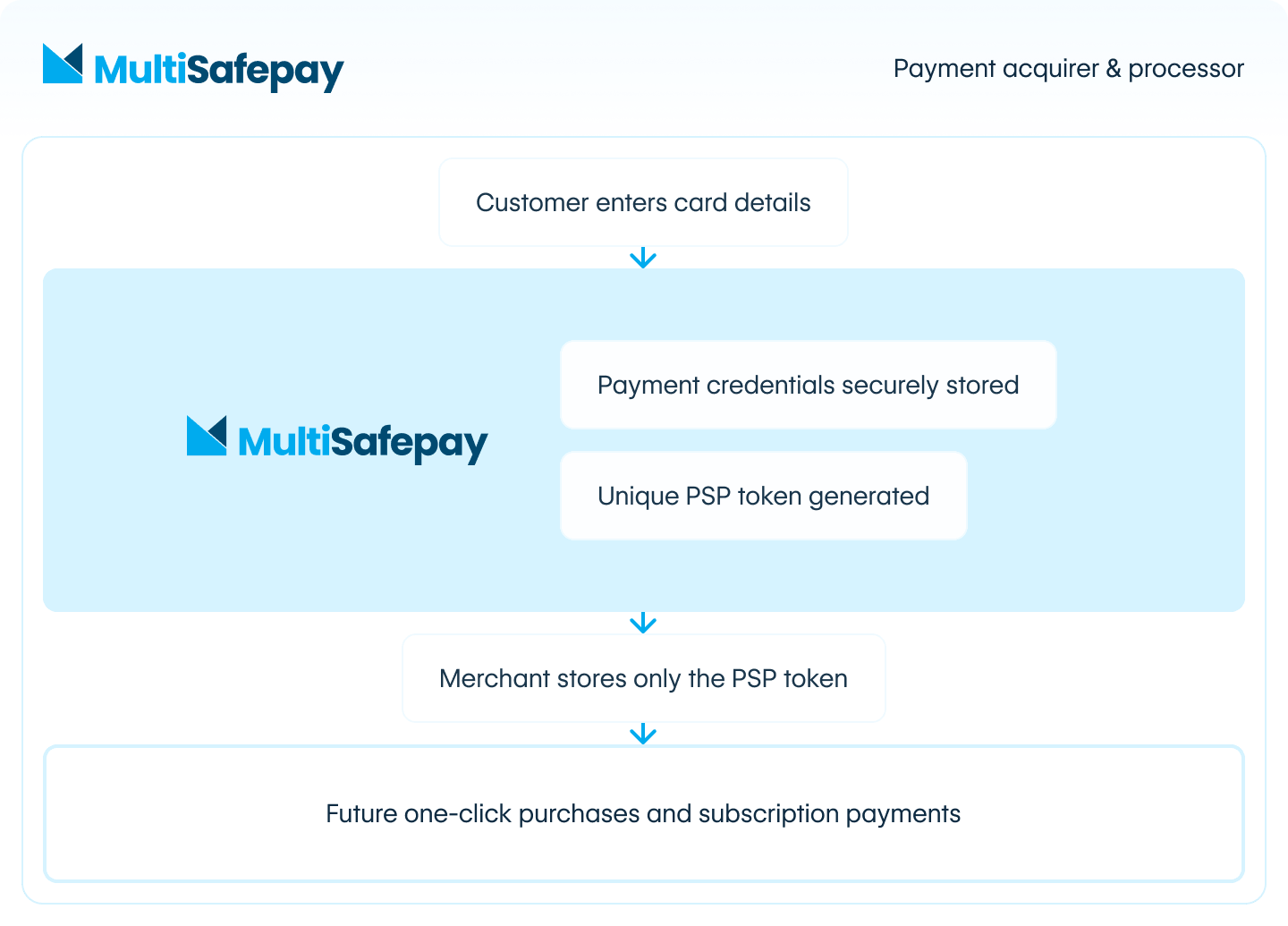
- The customer enters their payment details. During checkout, they enter their card information.
- The payment details are securely transmitted. The card information is sent over a secure, encrypted connection to your payment provider.
- A unique token is created. The payment provider replaces the card number with a random token and stores the original card data in their secure vault (not your servers).
- Token storage. Instead of storing sensitive card data, the merchant stores only the payment token and links it to the customer's account for future payments.
- Future purchases. On the next purchase, the merchant sends the token instead of the customer's card details. MultiSafepay securely maps the token to the original payment credentials and processes the transaction.
The token itself is simply a placeholder. It contains no usable card information and can only be used by the merchant account that generated it (through its associated API key). This means it can't be used by other merchants or systems to retrieve or process the original card details.
Tokenization: the real business impact
Beyond improving payment security, tokenization helps merchants create faster checkout experiences, support recurring payments, and reduce friction throughout the customer journey. Here's how it impacts your business.
1. Enable faster repeat checkouts
Returning customers expect a seamless checkout experience. Instead of entering their card details every time they make a purchase, tokenization allows them to securely pay using their saved payment method.
This means:
- Faster checkout, especially on mobile devices.
- Less friction during repeat purchases.
- Higher customer satisfaction and repeat purchase rates.
Result: More completed purchases and a smoother checkout experience.
2. Power recurring payments and subscriptions
For subscription businesses, memberships, SaaS platforms, and any business charging customers on a recurring basis, tokenization is essential.
When customers choose to save their payment method, MultiSafepay securely stores their payment credentials in our PCI DSS-certified environment and generates a unique payment token.
During the initial payment, customers may be asked to complete Strong Customer Authentication (SCA), such as 3D Secure. Once they've authenticated and agreed to store their payment method, the stored token can be used for future eligible Merchant-Initiated Transactions (MITs), including subscription renewals, memberships, and recurring invoices.
💡If you ever change payment providers, you may not have to ask customers to save their payment method again. Through token portability, eligible stored payment credentials can be securely migrated between PSPs, helping minimize disruption to subscriptions and repeat purchases.
3. Recover revenue through smart payment retries
Stored payment tokens can support payment retries in certain situations. If a payment fails because of a temporary issue or a card-related error, your payment provider may be able to retry the transaction without requiring customers to enter their payment details again. When combined with smart retry logic, eligible payments can be recovered before they're lost.
Result: More successful transactions, recovered revenue, and reduced involuntary churn.
4. Support omnichannel commerce
Tokenization helps create a consistent payment experience by securely linking the same payment method across multiple sales channels, making repeat purchases faster wherever customers choose to shop. Omnichannel is non-negotiable. A customer saves their card online and uses it:
- In-store at your POS terminal
- On mobile app with a single tap
- In your subscription portal to manage billing
- Across any channel your business operates
Result: Consistent payment experience. Higher conversion. Better customer experience.
Where is tokenization used?
Tokenization powers many of the payment experiences customers expect today. Whenever payment details need to be stored securely for future use, tokenization is often working behind the scenes.
Common examples include:
- Saved cards: Customers can securely save their payment details for faster future purchases.
- One-click checkout: Returning customers can complete their purchase without re-entering their card information.
- Recurring payments and subscriptions: Businesses can automatically process subscription fees, memberships, or recurring invoices.
- Mobile apps: Customers can make purchases with a single tap after saving their payment method.
- Omnichannel commerce: Customers can enjoy a consistent payment experience across online, in-store, and mobile channels.
If you've ever paid with a saved card or had a subscription renew automatically, you've already experienced tokenization in action.
How tokenization improves payment security
When customers save their payment details through MultiSafepay, the sensitive card data is securely stored in our PCI DSS-certified environment, not on the merchant servers. Instead of storing card numbers, merchants store only a payment token that has no value outside the secure PSP environment.
For merchants, this means:
- You don't store customers' sensitive card data.
- Your PCI DSS scope is significantly reduced.
- The risk of exposing payment credentials in a data breach is much lower.
- Customers can securely save their payment method for one-click purchases and recurring payments.
It's important to remember that tokenization protects stored payment credentials. It isn't designed to prevent every type of fraud.
If attackers gain access to a merchant's systems, they won't find customers' actual card details because only payment tokens are stored.
Tokenization is one layer of a modern payment security strategy. While tokenization protects stored payment credentials, technologies such as Strong Customer Authentication (SCA) help verify a customer's identity during eligible transactions.
Who can benefit from tokenization
Whether you sell products, subscriptions, or services, tokenization helps create faster, more secure payment experiences that encourage customers to come back.
How to implement tokenization in your business
If you're using a modern payment service provider (PSP) like MultiSafepay, tokenization is built in. You don't need to build it yourself.
The integration process is straightforward:
- Choose a payment platform that supports tokenization (ideally direct - native support, not third-party processors)
- Integrate their API or use their pre-built checkout solution
- Enable tokenization in your dashboard
- At checkout, offer customers the option to save their payment method
- On repeat purchases, retrieve and use the stored token
That's it. The technical heavy lifting is handled by your payment provider. You just activate it and let it work.
Why tokenization matters for modern commerce
Tokenization has become essential infrastructure for any business handling repeat payments.
It solves a specific problem: how to let customers save their payment methods securely while reducing your liability and compliance burden. It's not about flashy features.
Why now?
Tokenization isn't just a best practice anymore, it's where the payments industry is heading. Mastercard has announced its ambition to achieve 100% ecommerce tokenization in Europe by 2030, with the long-term goal of replacing manual card entry with faster, more secure payment experiences. Today, tokenization already secures around 25% of Mastercard's global ecommerce transactions, and adoption continues to accelerate.
Ready to simplify your payment operations with tokenization?
Frequently Asked Questions
<h6>What is network tokenization?</h6>
Network tokenization is a type of tokenization provided by card networks such as Visa and Mastercard. Unlike standard payment tokens issued by a payment service provider, network tokens can automatically update when a customer's card expires or is replaced, helping improve payment authorization rates and reduce failed transactions.
<h6>Can a payment token expire? </h6>
Yes. Whether a payment token expires depends on the payment provider or card network that issued it. Tokens may become invalid if a customer removes a saved payment method, replaces their card, or if the provider revokes the token for security reasons.
<h6>Does tokenization work with digital wallets? </h6>
Yes. Digital wallets such as Apple Pay and Google Pay use tokenization to protect payment credentials. Instead of sharing the customer's actual card number during a transaction, a unique payment token is used to authorize the purchase securely.
<h6>What's the difference between tokenization and vaulting? </h6>
Tokenization replaces sensitive payment data with a unique token, while vaulting refers to the secure storage of the original payment credentials. The two technologies work together: the vault stores the card data securely, and the token is what merchants use for future transactions.
<h6>Can tokenization help improve payment authorization rates? </h6>
Yes. When combined with technologies such as network tokenization and account updater services, tokenization can help reduce declines caused by expired or replaced cards, leading to higher authorization rates and a better customer experience.