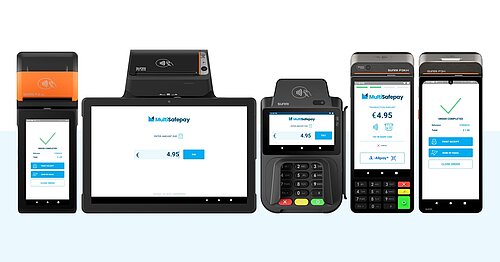
Tap to Pay in 2026: Turn any device into a smart checkout
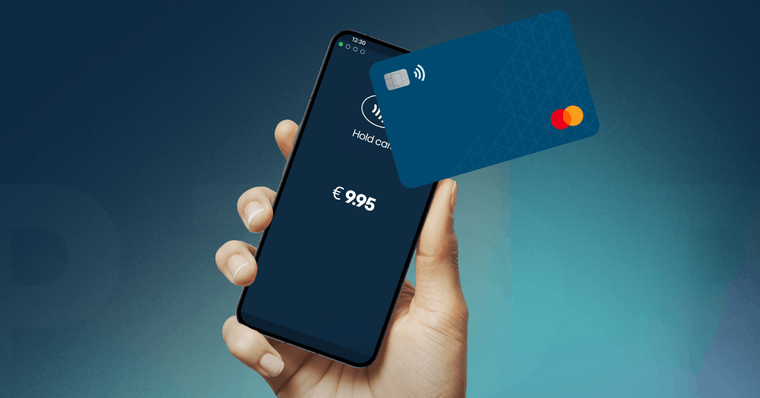
No spare terminals? No problem. Here’s everything you need to know about Tap to Pay, so you are ready for when we launch our own app.
Share this article


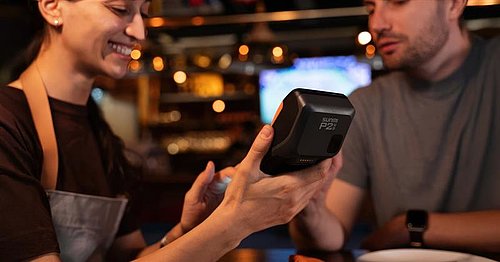
It is Saturday afternoon. The queue at your checkout is growing. Your staff doesn’t have a spare terminal. A customer at table six wants to pay. And somewhere across town, another store just turned every employee’s phone into a payment terminal.
What is Tap to Pay?
A payment terminal. No hardware needed.
It goes by many names: SoftPOS, Tap on Glass, Tap on Phone. Pick your favorite. They all refer to the same thing, we call it Tap to Pay.
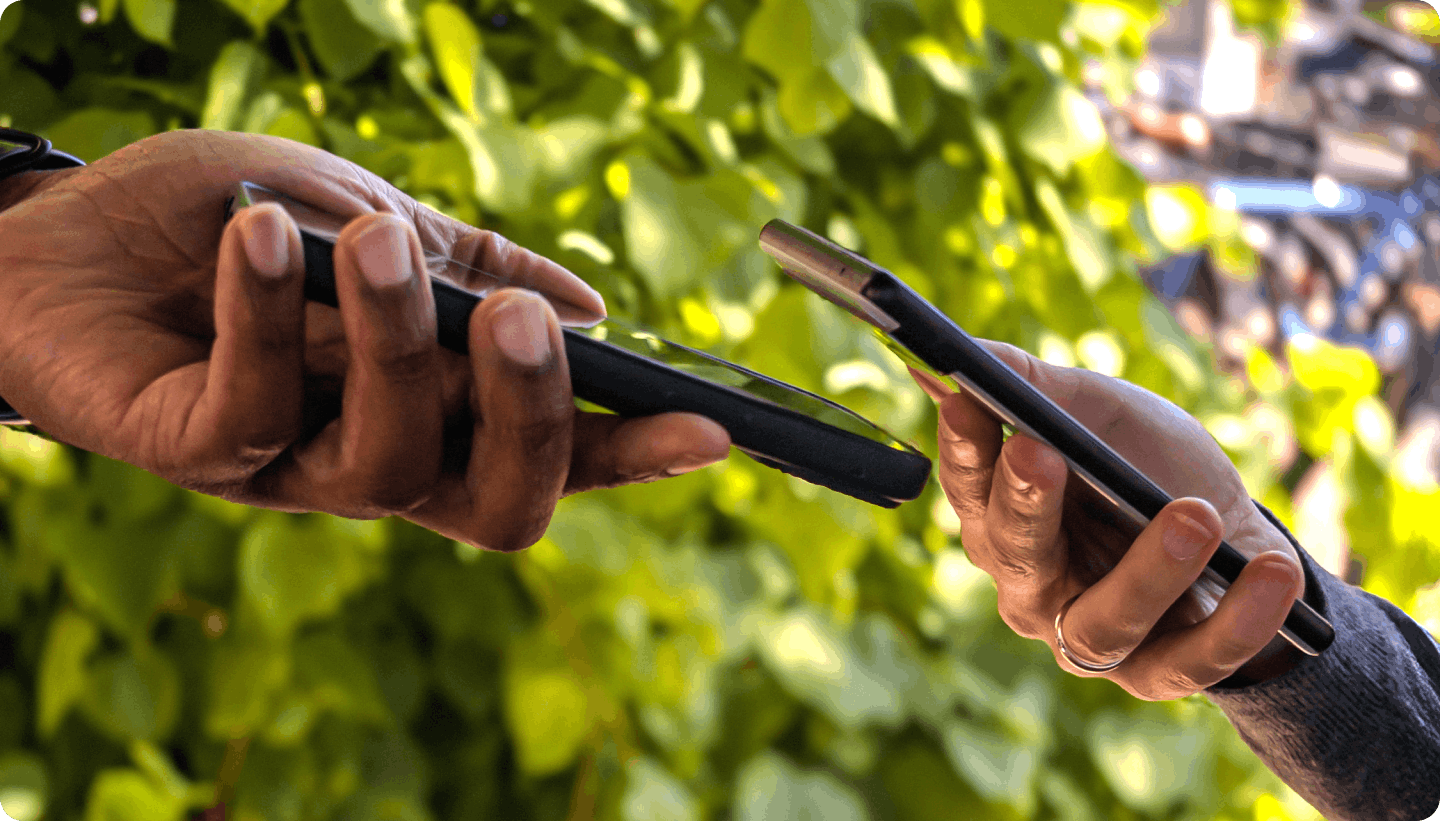
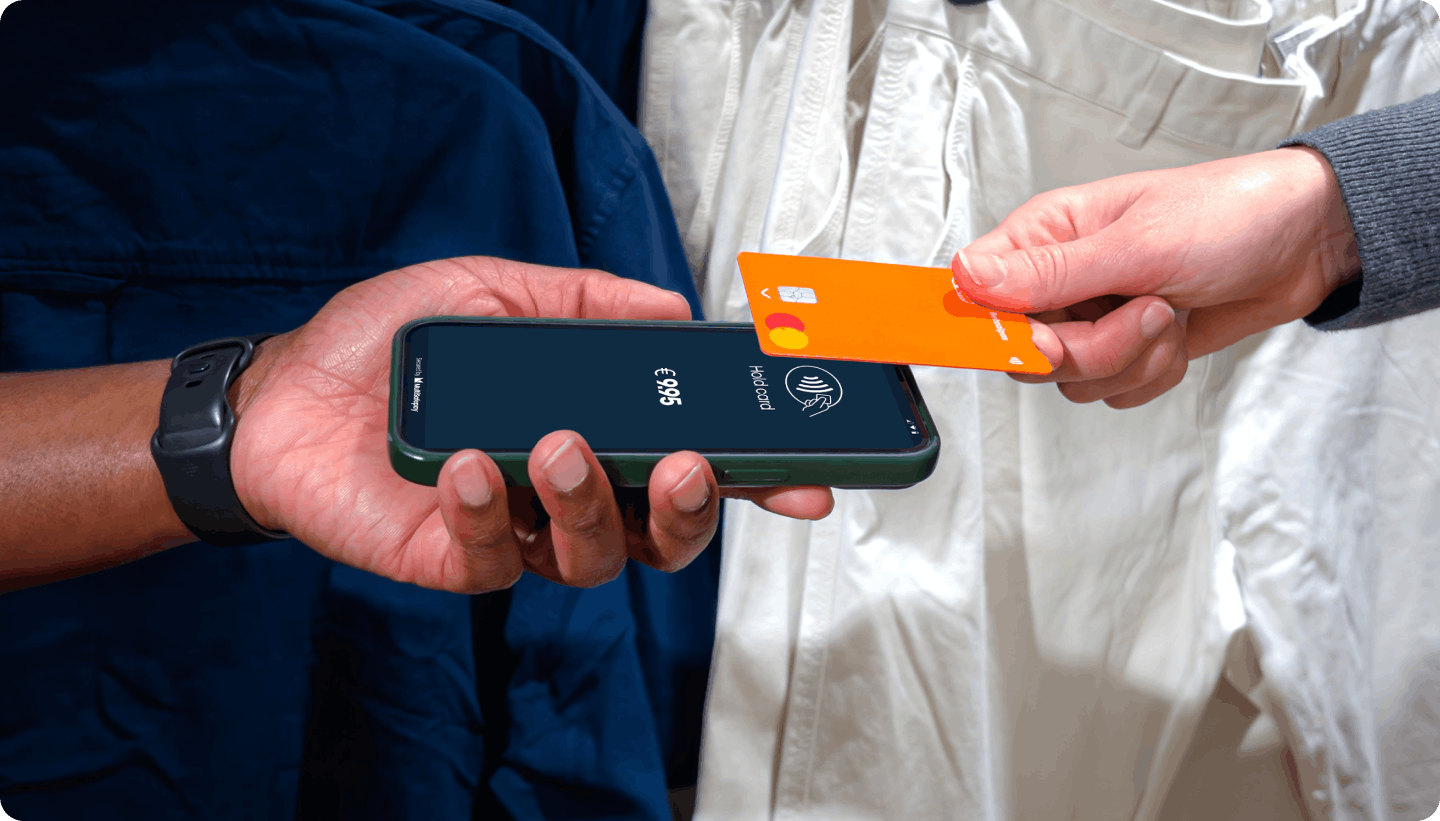
What it does is simple: it turns an NFC-enabled smartphone or tablet into a certified contactless payment terminal. No card reader. No hardware. Just an app, a device you already own, and a customer ready to pay.
Tap to Pay accepts contactless Visa and Mastercard, digital wallets like Apple Pay and Google Pay and wearables. If your customer can tap it, you can process it.
How it works
- Download and install a certified Tap to Pay app on your NFC-enabled smartphone or tablet.
- Enter the amount in the app when the customer is ready to pay.
- The customer taps their card, phone, or wearable against your device. The NFC-chip reads the payment credentials.
- The app encrypts the transaction data and sends it for authorization via 4G, 5G, or wifi.
- Both you and your customer receive a digital confirmation. The payment settles through your payment provider.
The full flow takes seconds. No rebooting. No cable, and no counter required.
Why merchants are making the switch
Traditional payment terminals come with some trade-offs: they need a fixed location, take time to order and configure, and can come with significant upfront hardware costs depending on your needs. Tap to Pay removes those constraints.
- Lower upfront costs: Tap to Pay runs on a device you already own. The upfront investment is zero.
- More flexibility: Your checkout goes wherever you go. Tap to Pay works anywhere with a 4G, 5G or wifi connection.
- Instant scalability: Need extra payment points during a peak period? Any Android or Apple device becomes a checkout point instantly. No advance ordering. No waiting.
- Faster checkout: Tap-only is faster than insert or swipe. Shorter queues. Smoother experience. More customers served in less time.
The shift to Tap to Pay has been happening for a while and the Netherlands leads the way in Europe. In 2025, nearly 6 in 10 PIN payments in the Netherlands were made contactless using a smartphone or smartwatch. That is up from just over 4 in 10 in 2024 - a jump of roughly 20% in a single year. Dutch consumers are not just comfortable with contactless. They are actively choosing the phone over the card.
Where Tap to Pay works best
Different industries mean different ways of working. Here’s an overview how Tap to Pay could benefit your operation
Retail
Long queues at a single checkout point are bad for sales. With Tap to Pay, any staff member on the floor becomes a checkout point. Use it for reducing queues during peak hours, as a backup when the main terminal goes down, or to close a sale on the spot.
Food and Beverage
Pay-at-table is the standard customers now expect. Tap to Pay makes it possible without investing in dedicated handheld terminals for every staff member. Run your ordering app and Tap to Pay on the same device. Use it on the terrace, in the back garden, or wherever your customers are.
On-the-go and transport
For freelancers, drivers, traders, or food truck operators, Tap to Pay is often the only payment method they need from day one. No upfront hardware costs. No waiting for a terminal to arrive and configure. A furniture delivery team, a mobile hairdresser, and a plumber can all take payments on the spot, on any device.
Events
Speed is everything at events. Long queues at a merchandise or concession stand mean lost sales. Tap to Pay lets every staff member take payments independently. It also works as a reliable backup when payment issues occur due to a timeout or declined transaction. Having a separate Tap to Pay device on standby can help with preventing downtime and never missing a sale.
Note for mobile businesses and startups: Tap to Pay is not just a supplement to existing hardware. For many businesses, it can be the entire payment setup from day one, with zero upfront investment.
Is Tap to Pay secure?
The standards behind Tap to Pay are the same ones that govern every payment method in Europe.
Tap to Pay is backed by the PCI MPoC standard (Mobile Payments on COTS devices), which covers 192 individual security requirements. Both Visa and Mastercard require certified compliance before any Tap to Pay app can go live. The certification is not optional. It is the baseline.
Payment credentials are encrypted at the point of contact and transmitted securely for authorization. The device itself never stores raw card data.
What Tap to Pay cannot do (yet)
Although Tap to Pay is a strong solution, it is not the right fit for every situation. Here is what to keep in mind.
- It requires NFC. Older devices without NFC-chips can’t run Tap to Pay. Most modern Android smartphones or tablers support it. iOS support is more restricted and depends on Apple’s own Tap to Pay program.
- It requires internet. No connection means no payment. In locations with unreliable 4G, 5G or wifi, a traditional terminal may be more reliable.
- Contactless only. Tap to Pay does not support chip-and-PIN or swipe. Customers without a contactless card or digital wallet cannot pay this way.
- Transaction limits vary. Contactless limits differ by country and card issuer. High-value transactions may require additional authentication steps.
- iOS is more limited than Android. Apple Tap to Pay is available in select markets and requires integration through an Apple-approved payment platform. Android offers broader flexibility for most deployments today.
For high-volume fixed checkout lanes, rugged environments, or setups that need peripherals like receipt printers, a traditional terminal remains the better choice. The two approaches work well together. Tap to Pay handles the flexible and overflow scenario. Hardware handles the core, high-volume points.
The market is moving fast
Consumer expectations have already shifted, and the numbers confirm it.
In 2024, 55.3 billion contactless card transactions were processed in the eurozone with 25.8 billion in H1 and 29.5 billion in H2. Year-on-year growth ran between 13% and 15.5%, according to the European Central Bank. Contactless is not a trend. It is becoming the default.
At the same time, traditional POS terminals are declining in mature European markets. In the UK and across the Nordics, terminal counts are falling as merchants shift to software-led payment acceptance. The direction is clear, and the rest of Europe is likely to follow.
Mordor Intelligence estimates that SoftPOS could account for 15 to 20% of new merchant accounts in Europe by 2027, particularly among micro and small businesses.
- For retailers and F&B operators: consumers already expect contactless. Merchants who cannot offer it risk losing sales at the moment it matters most.
- For on-the-go and event merchants: the barrier to starting has never been lower. Tap to Pay means you can accept card payments from day one, with no hardware investment.
- For everyone: the window to get ahead of this shift is now. Not in some future scenario. Right now.
What MultiSafepay is doing
We are launching our own Tap to Pay solution soon, currently in the pilot phase. When it arrives, merchants will get a fully integrated Tap to Pay experience within the MultiSafepay platform. The same dashboard, the same settlement, and the same support.
Next steps
Curious about how Tap to Pay could fit into your business? Contact us and we'll help you find the right configuration for your market, your operation, and your growth goals. Looking to get more from your in-store payments? Visit our in-store payments page to see how our solutions help you deliver a consistent, connected experience at every point of sale.